Iron during pregnancy: Why the right level is crucial
Iron deficiency during pregnancy _______
An evidence-based guide for expectant and new mothers
From prevention to therapy – with the latest study findings
Why iron is vital during pregnancy
Iron is key for the oxygen supply to both mother and child. During pregnancy, iron requirements increase to 30 mg/day (DGE, 2023) – double the normal requirement! Reasons:
- Blood volume increase of 40% : For the placenta and fetal circulation.
- Fetal development : Until birth, the baby needs around 300 mg of iron, and the placenta needs an additional 50 mg.
- Reserves for childbirth : Up to 500 mg of iron are stored for possible blood loss.
Studies show:
- Women with ferritin < 30 µg/L before pregnancy have a 3-fold increased risk of premature birth (Georgieff et al., 2020).
- Iron deficiency in women trying to conceive can cause menstrual irregularities and implantation problems (Holzer et al., 2023).
Symptoms: When you should take action
- Iron deficiency often manifests itself subtly. Typical warning signs
- Extreme fatigue (despite sufficient sleep)
- Pale skin, brittle nails, cracked corners of the mouth
- Rapid heartbeat, shortness of breath even with minimal exertion
- Dizziness or difficulty concentrating
Basic diagnostics during pregnancy
Blood test
| parameter | Normal range | Iron deficiency anemia (IDA) |
|---|---|---|
| Hemoglobin (Hb) | ♀: 12–16 g/dL | < 12 g/dL |
| MCV | 80–100 fl oz | < 80 fL (microcytic) |
| MCH | 27–34 pg | < 27 pg (hypochromic) |
| RDW | 11–14% | > 15% (increased) |
Other reference values during pregnancy:
| parameter | Normal value | Iron deficiency | anemia |
|---|---|---|---|
| HB | ≥ 11 g/dL (1st/3rd trimester) | – | < 11 g/dL (1st/3rd drink) < 10.5 g/dL (2nd drink) |
| Ferritin | 30–300 µg/L | < 30 µg/L | < 15 µg/L |
Source : Swiss Society of Gynecology (SGGG), 2023
Additional information: Ferritin alone is not enough!
- If iron deficiency is suspected, the CRP level should also be determined to rule out inflammation or infection.
-
Ferritin is a so-called acute-phase protein – in cases of inflammation, it can be falsely elevated or appear normal. Therefore, supplementary transferrin saturation testing is recommended.
A value of less than 20% usually indicates an iron deficiency.
New findings: Iron deficiency & fertility
- Ovulatory infertility : Women with ferritin < 30 µg/L have a 32% higher risk (Chavarro et al., 2006).
- Embryonic development : Iron supports egg maturation and placenta formation (Zhang et al., 2022).
- Practical tip : Test ferritin, transferrin & CRP levels when trying to conceive – not just Hb!
Meeting iron requirements: Diet vs. Supplements
1. Nutrition
-
Heme iron (animal) :
Beef (3 mg/100 g), salmon (1 mg/100 g)
→ Absorption: 15–35% -
Non-heme iron (plant-based) :
Lentils (8 mg/100 g), pumpkin seeds (12 mg/100 g)
→ Absorption: 2–20% -
Vitamin C Booster :
Eating bell peppers or orange juice with a meal increases absorption by up to 50%. -
Avoid inhibitors :
Coffee, black tea, and dairy products reduce absorption.
2. Supplementation
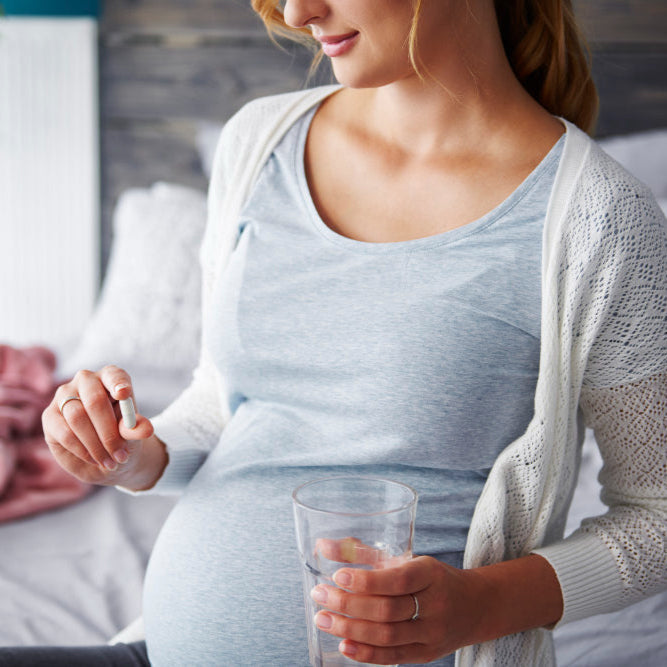
- Multivitamin such as Femme Pränatal® (2 capsules = 15 mg iron). Take daily in the morning on an empty stomach if the iron dose is ≤ 40 mg.
- In case of increased need, it is recommended to supplement the multivitamin with higher doses of iron – e.g. Floradix® (45 ml contains 36.8 mg iron) – every two days on an empty stomach in the morning to achieve a cumulative iron intake of ≥ 40 mg .
- Mild deficiency (ferritin 15–30 µg/L): 60–200 mg iron every 2nd day in the morning on an empty stomach.
- Severe anemia or intolerance to the oral dose from the 2nd/3rd trimester onwards (Hb < 9 g/dL): IV iron administration (e.g., Ferrinject®). NOT in the 1st trimester.
Study results
- Alternating dosing (100 mg every 2 days) reduces gastrointestinal side effects from 45% to 18% – with the same efficacy (Stoffel et al., 2020).
- Low dose (< 40 mg/day) shows a comparable increase in Hb as higher doses, but ~60–65% fewer side effects (Simic et al., 2023; PMC study, 2023).
compatibility
GI side effects :
-
- <40 mg/day : 10-20% (PMC9715811).
- 80–120 mg/day : 45–72 % (study by Madan et al., 1999).
Reasons :
-
-
Lower levels of unabsorbed iron residues in the intestine → less oxidative damage and inflammation (Burgerstein Foundation, 2024).
-
Practical tips
- Vitamin C combination : Increases the absorption of non-heme iron by 50%.
- Time of intake : In the morning on an empty stomach, as hepcidin levels naturally rise in the evening.
- Formulation : Iron bisglycinate (20–25 mg/day) is better tolerated than sulfates (Burgerstein Foundation, 2024).
Ferritin and CRP levels should always be measured for individual dosage recommendations!
Postpartum management
- Breastfeeding : requirement of 20 mg/day (DGE, 2023)
- Monitoring : Ferritin 6–8 weeks after birth – especially after blood loss or cesarean section
- IV iron postpartum : shortens recovery time when Hb < 10 g/dL (Hanusch et al., 2024)
- Warning : Iron deficiency increases the risk of postpartum depression by 37% (PMC9715811)
FAQs – Frequently Asked Questions
How often should iron levels be checked?
- Routine : Hb level at initial examination & 24th–28th week of pregnancy
- High-risk patients : monthly ferritin + CRP
2. Can too much iron be harmful?
Yes – ferritin > 300 µg/L increases e.g. B. the risk of diabetes (Ataide et al., 2023)
3. Does Femme prenatal® help in cases of severe deficiency?
No – if ferritin < 15 µg/L, you need 100–200 mg of iron every 2 days plus vitamin C.
Conclusion
- Iron deficiency during pregnancy is avoidable – through early diagnosis, targeted nutrition and individually tailored supplements.
- Recommendation:
- Before pregnancy : Check ferritin levels
- From week 20 of pregnancy : Alternating dose (100 mg every 2 days) – as needed
- Shortly before or after birth : Replenish iron stores, possibly also with IV iron.
Sources:
- Holzer I. et al. (2023), Frontiers in Endocrinology
- Stoffel NU et al. (2020), Haematologica
- German Nutrition Society (DGE, 2023)
- Hanusch et al. (2024)
- Ataide et al. (2023)
- PMC9715811: Comparison of different doses of daily iron supplementation in pregnancy
- PMC4011041: Low-dose iron supplementation in non-anemic women
- Burgerstein Foundation (2024): Iron supplements: Less is more
Last updated: March 2025
With this knowledge, you can consciously and confidently shape your pregnancy – for a healthy future for mother and child!
Yours, Valesca